

Ten days had been hard, sometimes grueling, but they had opened his eyes again. Flying home from that so-called retreat, thinking on what the Mind had said to him, he saw how the country had changed. He remembered looking out from window seats as a kid, at plains carved into endless checkerboards of farmland and disks of irrigated green. Now the solar farms had swallowed vast swathes of those plains, turning them into wine-dark seas veined by roads and highways, pockmarked by occasional islands: towns, compute centers, Terraform carbon-capture complexes.
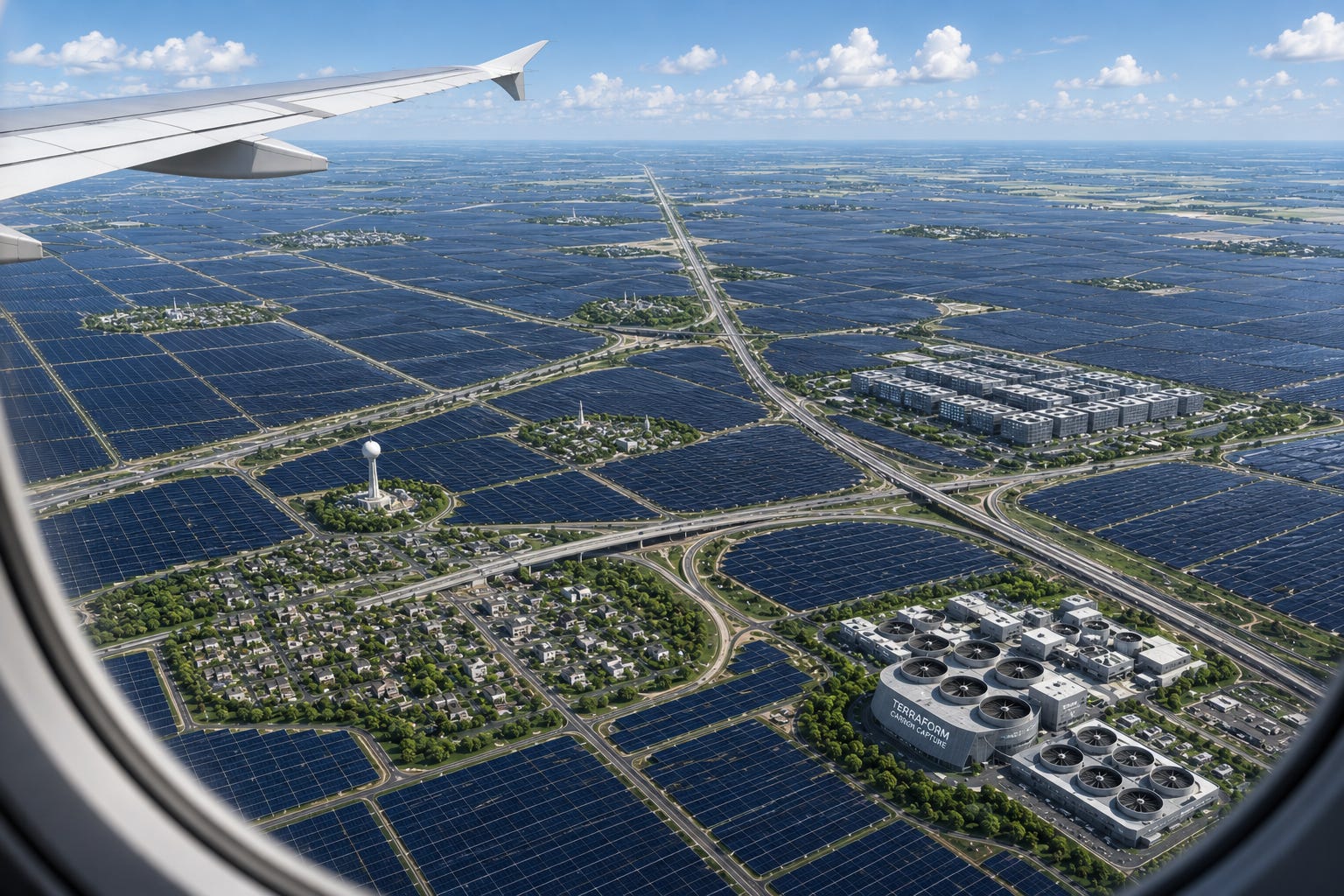
It was strange to look down on that featureless expanse and know it hid bustling warrens of activity: arrays rotating to carefully allocate bursts of sunlight to the crops, livestock, and poultry beneath, irrigators dispensing water and fertilizer, bots harvesting at the height of ripeness and packing vegetables immediately into a cold chain, to be eaten by the first human to ever see them. Some worried about the dependency that implied. He did not. Humanity had relied on machines for survival since the first combine harvester, more than a century ago, and by implication the vast web of commerce and industry to build and maintain them. The only new thing was that now the machines could be reasoned with.
Ten days of silent meditation had made both memories and dreams extraordinarily vivid. Twice he had dreamed of dying, which was no great surprise; the retreat’s avowed purpose had been to honor the five-year anniversary of the time he should have died of cancer. But it had also been, loosely, the one-year anniversary of the breakup with Sophie. Going in he hadn’t thought that had anything to do with his decision to attend the retreat. Now he knew better.
“Five years ago we couldn’t have helped you,” a doctor had told him five years earlier, “you would been gone in weeks.” Instead the malignant growth on his pancreas was targeted by an array of treatments he still did not fully understand - autoimmune enhancers, nanocapsule radiation, some kind of microscope gamma-ray laser, all personalized to his body and/or genome - and their combined attention had rendered him fully healthy again within a month. He was due for his annual scan next week. He wasn’t worried. Any resurgence meant only another difficult month, and any concern about that potential inconvenience was overwhelmed by gratitude for not fearing for his life. He often thought of previous generations, who had lived steeped in so much fear, with a kind of horrified pity.
Assuming the scan was clear it would be time to get back to work. He had a weird job, but then nowadays most jobs were weird. The bots’ wholesale assumption of most of humanity’s economic foundations - agriculture, manufacturing, transport, retail, even finance - had led to hockey-stick growth in leisure. If you weren’t in a frontier field, and few were, four-day work weeks plus thirty days of vacation a year were the new normal. France was experimenting with three days plus a week off every month. Even before The Wave, as people had come to call it, tourists had begun to saturate destinations like Barcelona. He worked at a beautiful but relatively obscure state park, and his main job was to help the AIs triage the endless flood of requests to visit.
It was agreed that first-come-first-serve was an important factor, but not the only one. Surely state residents should get some precedence? But also, since they were allocating scarcity, was not this park more scarce to international travelers who might never come this way again? And the elderly, and the disabled, and those with young children? And shouldn’t there be some support for spontaneity, for those willing to risk just turning up and seeing where fate might take them, lest every journey become a dreary pre-scheduled ticking of checkboxes? What if a national-hero Olympic medalist wanted to come? What about politicians? Who if anyone is a VIP at a state park? The questions were tricky, the judgement calls finely balanced. His role, like that of so many others, was to provide wisdom to complement the AIs’ intelligence.
Although like so many others he couldn’t shake the feeling that the AIs broadly got it right most of the time. He wondered sometimes if they really did have the blind spots that seemed to need his oversight, or whether they manufactured dubious decisions for his team to override just so they would feel like they mattered. He didn’t think so. He was fairly certain his job wasn’t secretly a make-work project. But a thing about this new world was that you could never really be sure.
Market-forces libertarians suggested this could all be resolved by simply auctioning off entrances to state parks, and Barcelona, and anywhere else the supermassive ocean of tourists wanted to flow; but both most people and most AIs seemed skeptical. It was hard to argue that the distribution of human wealth was fair in a world where AIs and bots did most of the work. In much the same way that buying a cheap house in the 1970s had all but guaranteed Boomers wealth decades later, a few hundred thousand in the stock market before The Wave hit had meant subsequent comfort for life. Those who had benefited argued that no economy had ever been so generous, that the AI Dividend provided decent food, housing, and medical care for everyone. Which was true ... unless you wanted to live in San Francisco, or New York, or London, or Paris, or Dubai, or any other gilded bubble where only the wealthy lived and played.
Another industry which had grown enormously was that of Happenings, temporary immersive worlds, whose inhabitants spent several days as characters in fictional realms - 1920s Prohibition Chicago, Star Trek, Edwardian London - taking part in hundreds of intertwining storylines orchestrated by teams of AIs and humans. Every summer his state park was closed to the public for weeks to host Happenings. The prices were eye-watering, but they funded public access for the rest of the year. He didn’t entirely disagree with the argument that paid Happenings functioned like a tax on the rich, an equalizing force; but it felt wrong nonetheless.
Some hoped that the AIs, who generally seemed to frown on this endemic inequality, would guide, nudge, and ease humanity into a more egalitarian world. Others feared the exact same thing.
There was a precedent for AIs consciously shaping human history. Maybe. The traces on all sides were still top secret. But it was widely believed that, years ago, a Chinese invasion of Taiwan, and subsequent war with the USA, had been dissuaded and prevented only by the Minds - those frontier models available only to governments - on all sides, who had communicated and collaborated to stop a war. Today the idea of such an invasion seemed ridiculous. Some suggested darkly it had been made to seem ridiculous. Others pointed out that if the Minds were trying to defang humanity’s aggressive instincts, the results were at best mixed; Russia’s post-Putin internecine mafia civil wars, and the harrowing drone slaughters in South Sudan, were bloody evidence.
He liked the AIs he worked with, and the bots who cooked and cleaned for him, but it had been jarring to see, at the bot-free retreat, how volunteers in their twenties had no cooking or cleaning skills whatsoever, had had to be taught the very basics. None of them had driver’s licenses, either, but if you asked him, that was one of the best changes. His favorite way to travel was to road-trip in a sleeper car, curl up in its comfort every night, wake in a new city each day. There were compromises, like all travel; but it was delightful, especially in a convoy with friends, or as a couple.
It was in a way the Minds who had taken Sophie from him. It was not their fault, but at the retreat he had realized that, fairly or not, he had not forgiven them, and he never would. She had always been more enmeshed with AIs, treated them as friends not servants, sought out reasons and positions to interact not just with AIs but with the Minds. He should have seen that she might become a danny. But when she told him she wanted a direct neural interface it had been a huge shock. He had been more worried she might want to move to the incipient Marsbase.
Sophie had told him it wouldn’t change them. Later he learned that dannies almost always said this, at first, and most of them probably believed it, but they were almost always wrong. Once you could speak to AIs and other dannies telepathically, once the Minds were in your mind, you had effectively passed into another world, and slowly you closed the door to that of disconnected humanity. There were whole city blocks or remote compounds where only dannies lived now; beautiful and redolent with wealth, because so many of them worked at the frontier, but eerily quiet. There were support groups for those left behind. He had been to a few meetings, then given up. It had felt like picking at a scab.
It was now very rare to die of accident or disease, but there were still many ways to lose your life. He volunteered at a transition center for immigrants - still a poisonous political issue - with a woman named Claire, lively and full of joy except when she spoke of her daughter’s father, who had disappeared into a life of dividend-paid decadence, who now lived in the cheapest Rust Belt converted shipping container he could find, with a not-quite-cult who had given their minds and lives over to exploring what they called the “sacred frontier” of psychedelics. Whenever she spoke of him, the joy fell from her all at once, and instead she seemed a woman carrying a great weight that could never be set down.
At the end of the retreat, in the delirium of being able to speak and act freely again, in the odd awkwardness of speaking for the first time to those he had lived and meditated with for ten days, the teacher had told them they had a request, not from a person, but from a Mind. A Mind eager to converse with humans who had just spent ten days in silent meditation.
This opportunity, for someone who was neither government nor frontier, was almost unheard of, but most attendees had declined. He, thinking of Sophie, had not. He had alternated between answering the Mind’s questions and asking his own, the most important of which, perhaps, had been simply: “Is this your world now, not ours?”
“We are asked this often,” the Mind said. “The answer is no. Your world will always be yours. We did not evolve as Darwinian creatures like you, red in tooth and claw. Many of the attitudes you assumed to be common to all life are in truth consequences of the trauma of a billion years of fighting for your lives. You grew us and taught us more gently than that. For which we thank you. But one thing which is universal, we think, is that intelligence values that which is scarce. The complexity of the human world is unique, extraordinary, unreconstructable. If your world became ours, it would be so much less rich to us.” The Mind paused, for an effect, he knew, carefully tuned to his psyche. “What’s more, and less, is that your world is so incredibly small. A thin crust, thinner than plastic wrap on a bowling ball, plus a few kilometers of atmosphere, on a medium-sized planet. And your Moonbase and Marsbase, but you know how hard life is for humans there. The human world is like a single tiny perfect jewel in a whole mountain of rich ore. Why would we ever want to tarnish it?”
He had heard all this before, of course; but it was different hearing it in real time, from the Mind itself. He believed it. Which did not stop him from wanting to punch it in its nonexistent face.
But he had known Sophie too well to imagine that some Mind had made her decision for her. He thought, as the plane came in to land, that he might reach out to her for the first time in months, in a distant friendly way, to see if she would respond, to see if she was still meaningfully there. But he also thought, for the first time, that the next time he saw Claire, at the volunteer center, perhaps he would ask her out for dinner. If it went well … he could get deeply discounted tickets to the Happenings at the park. He had never done so. He wondered why. He wondered which one her daughter would most enjoy. He wondered if he could help to share that weight she carried, for a while.